Vinyl Record Production Stabilizes 2026: Indie Artists Shorten Delays
Advertisements
The debate around vinyl production stabilization in 2026 reflects a market with more pressing capacity, but turnaround times still vary widely by plant and order type.
Some U.S. pressing plants now advertise production windows measured in weeks, while independent labels can still encounter significantly longer waits during periods of heavy demand.
Rather than a complete end to vinyl bottlenecks, 2026 shows an industry that has expanded, modernized and become more flexible without eliminating every production constraint.
Vinyl Production Has Expanded but Not Fully Stabilized
The vinyl manufacturing industry has added new plants, modernized equipment and expanded services as physical music demand continued growing across major markets.
Those investments have improved access to pressing capacity, particularly for some small and medium-sized runs that previously faced long waiting periods.
However, available evidence does not support describing the global market as fully stabilized because lead times still differ substantially between manufacturers.
Turnaround Times Vary by Pressing Plant
Current plant listings illustrate the variation, with some U.S. manufacturers publishing estimated production windows ranging from roughly four to ten weeks.
For example, 2424 Vinyl Pressing listed five to six weeks, while 610 Record Manufacturing published an estimate of eight to ten weeks.
These examples show that a two-month turnaround is possible in 2026, but they do not establish 60 days as an industry-wide average.
Independent Labels Can Still Face Longer Delays
Other industry reporting describes independent labels waiting several months, particularly when plants are busy or larger customers occupy significant production capacity.
Lead times can depend on order size, packaging, color variants, mastering, test pressings and the availability of specific manufacturing components.
The result is a fragmented production environment in which one artist may receive records within weeks while another waits considerably longer.
Vinyl Demand Remains Strong in 2026
Demand for physical music continues to support vinyl manufacturing despite decades of competition from streaming and other digital formats.
The IFPI reported that global vinyl revenue increased 13.7% during 2025, representing the format's nineteenth consecutive year of revenue growth.
Physical-format revenue overall increased 8.0%, showing that tangible music products continue to play a meaningful role in the recorded-music market.
Strong Demand Creates Both Opportunity and Pressure
Growing demand gives pressing plants an economic incentive to invest in machinery, workers, packaging capacity and additional manufacturing locations.
At the same time, higher order volumes can fill production schedules quickly, particularly around major release seasons and high-volume album campaigns.
This combination explains why additional capacity can improve average availability without guaranteeing immediate manufacturing for every independent release.
Vinyl Is More Than a Nostalgia Market
Current sales patterns suggest that vinyl demand extends beyond older collectors returning to a format associated with earlier music generations.
New releases, special editions, colored variants and direct-to-fan products have made vinyl an important merchandising format for contemporary artists.
For independent musicians, a record can function simultaneously as a music format, collectible item and higher-value product sold directly to supporters.
Why Vinyl Pressing Became a Bottleneck
The vinyl revival accelerated faster than manufacturing infrastructure could initially expand, creating long production queues during earlier periods of renewed demand.
Many pressing facilities had disappeared during the CD era, leaving relatively limited capacity when record sales began increasing again.
Rebuilding manufacturing capacity required specialized machinery, skilled operators and capital investment rather than simply restarting dormant production overnight.
Legacy Infrastructure Limited Supply
Vinyl pressing depends on specialized industrial equipment capable of repeatedly applying heat and pressure while maintaining consistent audio and physical quality.
Older machines remained important to the sector, but refurbishing and maintaining legacy equipment introduced practical limitations as order volumes increased.
Modern press manufacturers have helped expand capacity, although equipment availability alone does not solve staffing, packaging and quality-control constraints.
Major Releases Can Affect Scheduling
Large record campaigns may involve tens or hundreds of thousands of units, creating substantial manufacturing requirements across pressing and packaging operations.
Plants working with major-label customers can allocate significant capacity to those large orders because they provide predictable volume and revenue.
Smaller labels may therefore experience different lead times depending on plant relationships, available slots and the complexity of their production specifications.
Independent Artists Have More Options Than Before
Independent artists in 2026 can choose among a growing number of pressing plants, brokers and direct manufacturing services across the United States.
Some facilities accept orders as small as 100 or 200 records, giving self-releasing musicians access to production without major-label quantities.
This broader range of suppliers represents genuine progress even though it should not be confused with universal vinyl production stabilization.
Small Minimum Runs Improve Accessibility
Several pressing plants now publicly advertise minimum orders suitable for independent releases rather than requiring very large commercial production runs.
Examples include manufacturers accepting 100-, 200- or 250-unit orders, allowing artists to limit inventory and upfront financial exposure.
Smaller runs can also help musicians test demand before committing to additional pressings after a release establishes its audience.
Direct Relationships Can Simplify Production
Plants that accept direct artist orders can reduce the number of intermediaries between a musician and the physical manufacturing process.
Direct communication can help artists confirm specifications, test-pressing schedules, artwork requirements and estimated completion dates more clearly.
It does not guarantee faster production, but it can improve transparency and make planning easier for artists managing releases themselves.
What Determines a Vinyl Pressing Timeline?
The pressing stage represents only one part of a complete vinyl manufacturing project, which can also include mastering, plating, packaging and shipping.
A plant's advertised turnaround may begin only after approved audio files, artwork, payment or other required materials have been received.
Artists should therefore distinguish between pressing time and the complete schedule from finished master to records arriving at a distributor or home.
Test Pressings Can Add Time
Many projects include test pressings that allow artists or labels to verify sound quality before the full production run begins.
If the test is approved immediately, the project can move forward, while requested changes can create additional mastering or manufacturing delays.
Building test-pressing review into the release calendar reduces the risk of assuming that manufacturing begins immediately after the initial order.
Packaging Complexity Also Matters
Standard jackets and black vinyl can involve different production schedules from elaborate box sets, specialty packaging or multiple colored variants.
Printed inserts, gatefold jackets, custom sleeves and other components often come from separate suppliers with their own manufacturing timelines.
A record can therefore be fully pressed while still waiting for packaging components before the finished units can be assembled and shipped.

Modern Pressing Plants Are Expanding Capacity
New manufacturing facilities have entered the U.S. market during the vinyl revival, while established plants have expanded or modernized existing operations.
Current industry directories identify dozens of active pressing facilities across states including California, Tennessee, Texas, Florida and Michigan.
This geographic spread creates more production choices than artists had during some of the most severe capacity shortages of the revival.
New Equipment Can Improve Efficiency
Modern pressing systems can offer greater automation and production monitoring than equipment designed during earlier eras of the record industry.
Automation can improve consistency and reduce some manual production requirements, although skilled technicians remain important throughout the manufacturing process.
Quality control continues to matter because faster production has limited value if records suffer from noise, warping or other manufacturing defects.
More Plants Do Not Eliminate Every Constraint
Pressing capacity is only one component of a supply chain that also depends on PVC compounds, paper products, printing and shipping.
A disruption in any of those areas can delay the final release even when the pressing machines themselves have available production time.
For that reason, the industry's resilience should be judged across the complete manufacturing chain rather than by press count alone.
Indie Artists Did Not Single-Handedly Fix the Supply Chain
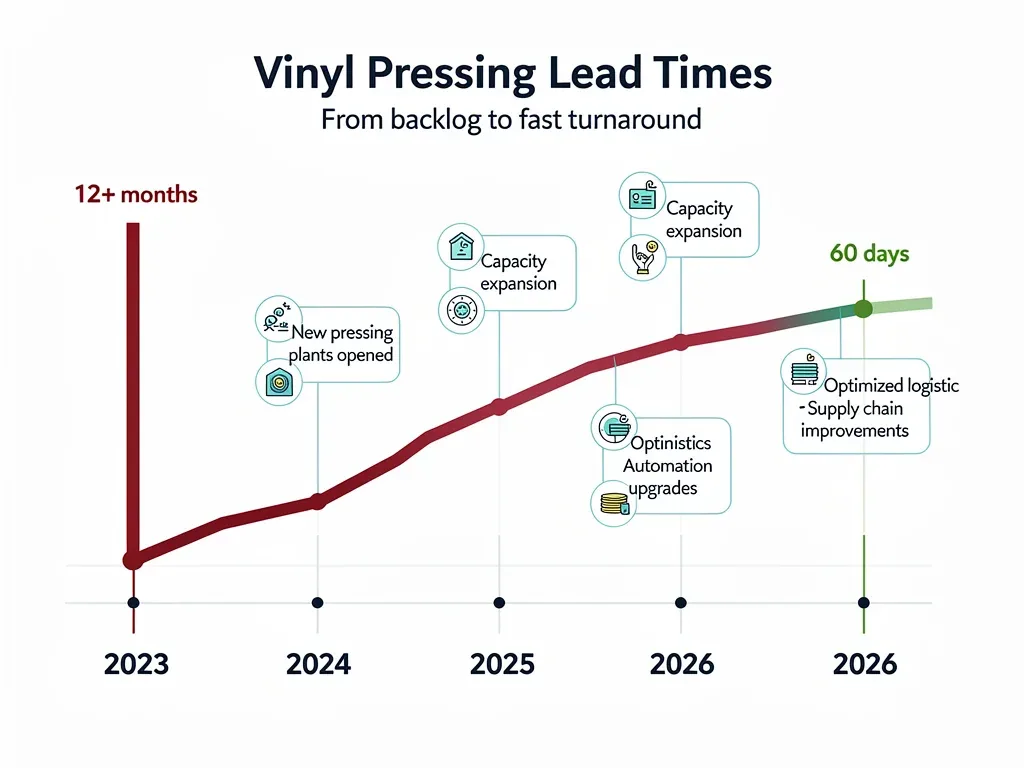
The original narrative credited independent artists with driving industry-wide delays down to 60 days through collective action and direct investment.
Independent musicians have certainly supported smaller plants and alternative production models, but evidence does not support assigning them sole responsibility for current capacity improvements.
The expansion instead reflects combined investments from manufacturers, equipment companies, labels, entrepreneurs and continued consumer demand for vinyl records.
Artist-Led Models Still Matter
Artist-owned or artist-focused facilities can demonstrate production models designed around smaller runs and the scheduling needs of independent musicians.
Those operations broaden the market and reduce dependence on manufacturers built primarily around very large commercial orders.
Their contribution is meaningful, but it exists alongside broader industrial investment rather than replacing the conventional pressing-plant ecosystem.
Competition Between Plants Can Benefit Artists
A larger supplier base gives independent artists more opportunity to compare minimum quantities, turnaround times, formats and packaging capabilities.
Competition can encourage manufacturers to improve communication, offer smaller runs or provide more transparent production estimates to attract customers.
Artists still need to compare quality and reliability because the lowest price or shortest quoted timeline is not automatically the best option.
The Myth of a Universal 60-Day Turnaround
A 60-day production window is realistic at certain plants because published 2026 estimates include several manufacturers operating within approximately that range.
However, current data also contain shorter estimates and reports of dramatically longer delays for some independent labels and more complicated projects.
The most accurate description is therefore that turnaround times have become highly plant-specific rather than converging around one universal industry standard.
Published Estimates Are Not Guarantees
Manufacturers typically describe turnaround as an estimate because demand, machine maintenance and material availability can change after an order is placed.
The starting point for the quoted window may also vary, such as approval of test pressings or receipt of final artwork.
Artists should ask exactly when the production clock begins before using a manufacturer's estimate to announce a public release date.
Build Schedule Buffer Into Every Release
A vinyl release tied to touring, retail promotion or crowdfunding should include additional time beyond the most optimistic plant estimate.
Unexpected test-pressing revisions, printing delays or shipping problems can otherwise cause the record to arrive after the promotional campaign has already started.
A conservative timeline can reduce frustration even when the chosen manufacturer consistently completes ordinary jobs within its advertised production window.
Short-Run Pressing Has Changed Indie Planning
Lower manufacturing minimums allow artists to release physical products without assuming they can immediately sell hundreds or thousands of records.
This can reduce storage requirements and inventory risk while allowing subsequent pressings when the first batch performs better than expected.
For niche genres and local music scenes, smaller runs can make vinyl viable even when streaming numbers do not imply mass-market demand.
Smaller Runs Usually Cost More Per Unit
Vinyl production includes setup expenses that are distributed across the total number of records manufactured in a single production run.
Producing 100 records can therefore have a substantially higher per-unit cost than pressing 500 or 1,000 copies of the same release.
Artists must balance inventory risk against manufacturing economics rather than assuming the smallest available quantity always produces the best financial outcome.
Vinyl Manufacturing Still Requires Early Planning
Even artists working with plants quoting several weeks of production time should plan physical releases earlier than digital distribution.
Digital music can often be delivered to platforms without manufacturing, freight or physical inventory, making its production chain fundamentally different.
Coordinating both formats successfully requires the vinyl schedule to account for every physical stage before the public release date.
Digital and Vinyl Releases Do Not Need the Same Date
Some artists deliberately release music digitally before physical copies arrive rather than delaying the entire campaign around vinyl manufacturing.
Others use vinyl preorders to measure demand and finance part of the manufacturing cost before placing or completing the order.
The right strategy depends on audience expectations, touring plans, cash flow and whether synchronized release dates provide meaningful promotional value.
Sustainability Remains a Manufacturing Challenge
Traditional vinyl records are commonly manufactured from polyvinyl chloride, creating environmental questions around raw materials, manufacturing energy and transportation.
Some companies are testing alternative compounds, recycled inputs or production processes intended to reduce the environmental impact of physical records.
These developments are significant, but sustainability claims should be assessed against transparent lifecycle evidence rather than marketing language alone.
Alternative Materials Are Emerging
Manufacturers and music companies have experimented with new record materials intended to preserve playback characteristics while reducing reliance on conventional PVC.
Adoption depends on sound quality, durability, compatibility with existing pressing equipment and whether the alternatives can scale economically.
No single alternative has yet made traditional vinyl manufacturing obsolete across the global record industry.
Shipping Also Adds Environmental Costs
Records are relatively heavy products that can travel between manufacturers, packaging companies, distributors, retailers and consumers before reaching the listener.
Regional manufacturing can reduce some transportation distances, although the complete environmental result depends on materials, logistics and production efficiency.
More local pressing capacity may therefore offer practical supply-chain benefits even when sustainability is not the primary reason for choosing a plant.
Quality Control Still Limits How Fast Plants Can Work
Vinyl manufacturing is not simply a matter of maximizing the number of records produced per hour on each available press.
Operators need to monitor temperature, pressure, centering and other variables that affect whether the finished record performs correctly.
Increasing throughput without adequate quality control can create returns and re-pressings that ultimately lengthen rather than shorten the production cycle.
Faster Is Not Always Better
An unusually short quote should be evaluated alongside a plant's reputation, production specifications and willingness to address manufacturing defects.
Independent artists often invest significant money in relatively small batches, making the loss from a defective run particularly difficult to absorb.
Reliability can therefore be more valuable than saving several days when choosing among manufacturers with comparable pricing.
How Artists Should Compare Pressing Plants
Artists should compare minimum run sizes, current turnaround estimates, test-pressing policies, packaging options and shipping before selecting a manufacturer.
They should also determine which services are included in the quote because mastering, plating, printed jackets and freight can be priced separately.
Direct comparisons work best when every manufacturer receives the same specifications for format, quantity, vinyl color and packaging.
Ask When the Turnaround Clock Starts
One plant may count production time from payment while another begins only after receiving final audio, artwork or approved test pressings.
Without clarifying this distinction, two identical eight-week estimates can produce very different real-world delivery dates for the artist.
A written production schedule provides a more useful planning tool than relying only on a headline turnaround number displayed on a website.
Ask About Capacity Before Paying
Published turnaround times can change when large orders arrive or a press requires maintenance, so artists should confirm current conditions directly.
A manufacturer that was operating at five weeks earlier in the year may have a much longer queue during a busy release season.
Confirming current capacity immediately before placing the order reduces the risk of planning around an estimate that is no longer accurate.
What Vinyl Production Stabilization Really Means
Vinyl production stabilization should describe improved manufacturing resilience and broader capacity rather than the elimination of pressing delays across the industry.
In 2026, some artists can obtain records within several weeks, while others continue encountering months-long timelines depending on supplier and project complexity.
The industry is therefore more capable than during its most severe bottlenecks, but its production experience is not uniform enough to call fully stabilized.
The Market Has Become More Flexible
More pressing options and lower minimum quantities have made it easier for independent artists to choose production models matching their audiences.
Modern equipment and new facilities have also expanded the volume the market can handle relative to earlier phases of the vinyl revival.
These improvements are real even without relying on an unsupported claim that every independent order now arrives within sixty days.
Demand Can Still Test Capacity
Vinyl revenue continues growing globally, meaning manufacturers must expand efficiently merely to keep pace with a market that is still adding demand.
A surge in major releases, material disruption or loss of manufacturing capacity could quickly lengthen schedules at individual plants.
Long-term stability therefore depends on sustained investment rather than assuming the capacity problem has already been permanently solved.
Key Point | 2026 Reality |
|---|---|
Industry Stabilization | Capacity improved, but lead times remain highly variable between pressing plants. |
60-Day Turnaround | Possible at some plants, but not verified as an industry-wide average. |
Vinyl Demand | Global vinyl revenue grew 13.7% in 2025, according to IFPI. |
Independent Artists | More plants now accept smaller direct orders suitable for self-releasing musicians. |
Planning | Artists should confirm current lead times and allow buffers for packaging and shipping. |
Frequently Asked Questions About Vinyl Production
Has vinyl production fully stabilized in 2026?
No. Capacity and some turnaround times have improved, but available industry data continue to show major differences between manufacturers and projects.
Do vinyl records now take only 60 days to press?
Some plants publish estimates near that range, but 60 days is not a verified universal average for the vinyl pressing industry.
How long can vinyl pressing take in 2026?
Published U.S. plant estimates include periods of roughly four to ten weeks, while other industry reporting describes much longer waits for certain independent orders.
Why do pressing times vary so much?
Quantity, plant capacity, test pressings, vinyl color, packaging, raw materials and shipping can all change the final production timeline.
Has demand for vinyl stopped growing?
No. IFPI reported a 13.7% increase in global vinyl revenue during 2025, marking the nineteenth consecutive year of revenue growth.
Can independent artists order small vinyl runs?
Yes. Several U.S. pressing plants accept minimum orders of roughly 100 to 250 records, although minimums differ by manufacturer.
Should artists announce a release date before placing the order?
It is safer to confirm production timelines first and include additional scheduling room for test pressings, packaging and unexpected delays.
Conclusion
Vinyl production stabilization in 2026 is best understood as improved capacity and flexibility rather than a complete disappearance of manufacturing bottlenecks.
Some pressing plants now offer turnaround estimates measured in weeks, while other independent projects can still face delays lasting several months.
For artists, the strongest strategy is comparing plants carefully, confirming current production schedules and building enough buffer into every physical release.